








Peking Union Medical College reveals that rosemarinic acid alleviates allergic asthma through the gut-lung axis
Asthma affects 3% of the world's population, causing more than 250,000 deaths and affecting more than 600 million people with symptoms. It has a serious impact on physical and mental health, leading to reduced work productivity, reduced physical capacity and reduced quality of life. Asthma is a significant economic burden, particularly for those with poorly controlled asthma and in low-income countries. Asthma is a complex disease influenced by genetic and environmental factors and triggered by infections, allergens and irritants. There is heterogeneity in airway inflammation and remodelling. Because of its complexity, asthma is difficult to treat or prevent. Asthma treatment focuses on reducing symptoms, maintaining normal activity levels and preventing deterioration in lung function. Anti-inflammatory and bronchodilator therapies, such as corticosteroids, beta2-agonists and anticholinergics, are the mainstay of asthma treatment. They are used gradually to control symptoms. Inhaled corticosteroids are considered the drug of choice for the treatment of acute asthma exacerbations and may be used in combination with intermediate-acting β2-agonists such as salbutamol, terbutaline and pyridostigmine for better therapeutic effect. Anticholinergics are also used to reduce bronchoconstriction and airway inflammation.
SXCF is extracted from the traditional Chinese herb Hardy Pointed Goddess of Mercy, which has long been used to control asthma. Rosmarinic acid (RosA), a phenolic compound identified in SXCF, has been shown to be its main active ingredient. Both clinical and experimental studies have shown that RosA is effective in treating asthma, modulates the immune system, protects the liver and kidneys, and is generally safe. However, the exact anti-allergic mechanism of RosA is unknown.
RosA is a water soluble phenolic compound, but its bioavailability is extremely low (~1.57%) due to its poor membrane permeability. Previous studies have shown that orally administered RosA is metabolised in the intestine to produce simpler, more easily absorbed phenolic compounds. These then undergo a binding reaction in the blood and are eliminated from the body via the kidneys. However, in our study, systemic concentrations of RosA and its metabolites remained below 0.5 ng/ml after oral treatment, indicating that neither RosA nor its metabolites are sufficient to produce an anti-asthmatic effect when taken orally, suggesting the involvement of the gut microbiota.
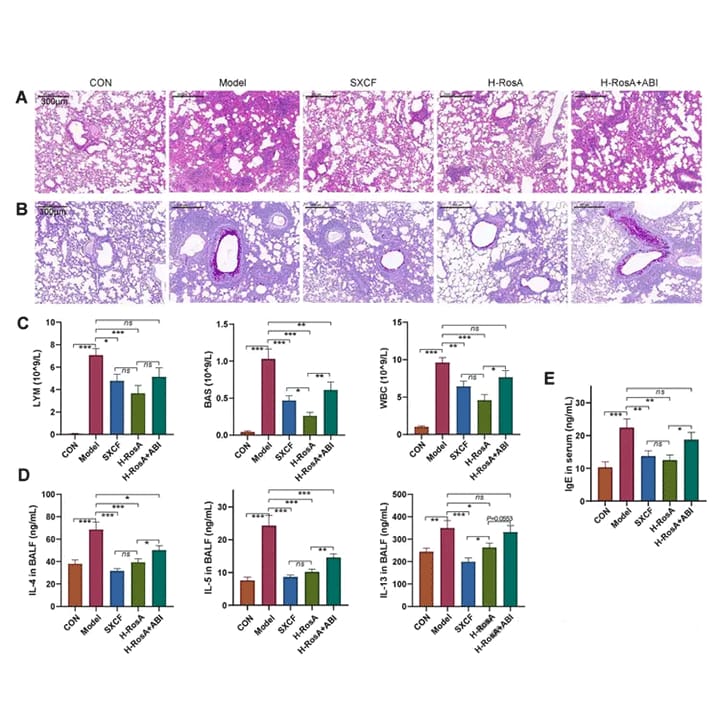
Comparison of SXCF and RosA in alleviating allergic asthma and gut microbiota involvement
5-HT, SCFAs and LPS act as signalling molecules that are intimately involved in the establishment of the anti-asthmatic effects of RosA through the gut-pulmonary axis. Specifically, RosA reduces the formation of bacterial-derived metabolites (mainly cholate) to inhibit 5-HT biosynthesis, thereby inhibiting 5-HT-mediated bronchoconstriction and vasodilation. In addition, reduced 5-HT levels inhibited IgE and mucus production by altering the metabolism of LMs (mainly TXA2 and 5HETE). In addition, RosA promoted the abundance of native probiotics and the associated synthesis of SCFAs, which in turn promoted the expression of intestinal tight junction proteins (ZO-1 and OCLN), contributing to overall gut health. In addition, SCFAs upregulated the expression of intestinal MCTs (MCT1, SMCT1 and MCT4), thereby enhancing their systemic delivery efficiency and further reducing Th2/ILC2-mediated inflammatory responses, IgE production, eosinophil influx and mucus production.RosA also inhibited the production and translocation of native pathogenic bacteria and associated LPS, thereby reducing TLR4-NFκB-mediated intrapulmonary inflammation.
In conclusion, our study shows that the anti-asthmatic mechanism of oral RosA is mainly driven by gut microbial metabolites that act as signalling molecules in the gut-lung axis.RosA activates multiple, complementary and partially overlapping pathways to achieve a combined synergistic effect. This makes RosA a safe, effective and reliable drug candidate with the potential to be used as an alternative to glucocorticoids in the treatment of asthma.